2012 Vp113

2012 VP 113, also known by its nickname 'Biden', is a trans-Neptunian object of the sednoid population, located in the outermost reaches of the Solar System.It was first observed on 5 November 2012 by American astronomers Scott Sheppard and Chad Trujillo at the Cerro Tololo Inter-American Observatory in Chile. 2012 VP113 live position and data This page shows Asteroid 2012 VP113 location and other relevant astronomical data in real time. The celestial coordinates, magnitude, distances and speed are updated in real time and are computed using high quality data sets provided by the JPL Horizons ephemeris service (see acknowledgements for details).
Astronomers Dr Chadwick Trujillo of Gemini Observatory in Hawaii and Dr Scott Sheppard of Carnegie Institution for Science have discovered a dwarf planet, scientifically called 2012 VP113 and nicknamed Biden, beyond the known edge of our Solar System.
Three images of 2012 VP113, each taken about two hours apart, were combined into one. The first image was artificially colored red, second green and third blue. 2012 VP113 moved between each image as seen by the red, green and blue dots. The background stars and galaxies did not move and thus their red, green and blue images combine to show up as white sources. Image credit: Scott Sheppard / Chad Trujillo.
Solar System can be divided into three parts: the rocky planets like Earth, which are close to the Sun; the gas giants; and the frozen objects of the Kuiper belt, which lie just beyond Neptune’s orbit.
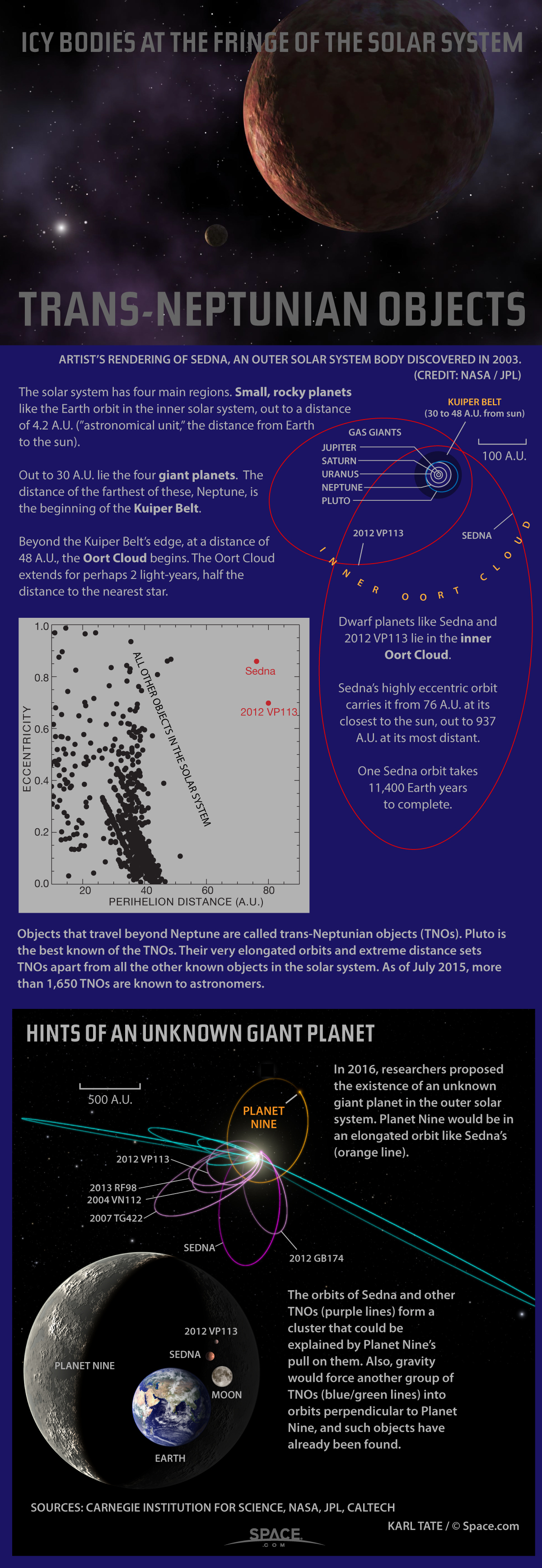
Beyond this, there appears to be an edge to the Solar System where only one object, Sedna, was previously known to exist for its entire orbit.
But the newly found dwarf planet has an orbit that stays even beyond Sedna, making it the furthest known in the Solar System.
Sedna was discovered beyond the Kuiper Belt edge in 2003, and it was not known if Sedna was unique, as Pluto once was thought to be before the Kuiper Belt was discovered.
With the discovery of 2012 VP113 it is now clear Sedna is not unique and is likely the second known member of the hypothesized inner Oort cloud, the likely origin of some comets.
2012 VP113’s closest orbit point to the Sun brings it to about 80 AU.
For context, the rocky planets and asteroids exist at distances ranging between .39 and 4.2 AU. Gas giants are found between 5 and 30 AU, and the Kuiper belt ranges from 30 to 50 AU. In our Solar System there is a distinct edge at 50 AU. Only Sedna was known to stay significantly beyond this outer boundary at 76 AU for its entire orbit.
This is an orbit diagram for the outer Solar System. The Sun and Terrestrial planets are at the center. The orbits of the four giant planets, Jupiter, Saturn, Uranus and Neptune, are shown by purple solid circles. The Kuiper Belt, including Pluto, is shown by the dotted light blue region just beyond the giant planets. Sedna’s orbit is shown in orange while 2012 VP113′s orbit is shown in red. Both objects are currently near their closest approach to the Sun. Image credit: Scott Sheppard.
“The search for these distant inner Oort cloud objects beyond Sedna and 2012 VP113 should continue, as they could tell us a lot about how our Solar System formed and evolved,”said Dr Sheppard, who is the second author of a paper published in the journal Nature.
The astronomers determine that about 900 objects with orbits like Sedna and 2012 VP113 and sizes larger than 1,000 km may exist and that the total population of the inner Oort cloud is likely bigger than that of the Kuiper Belt and main asteroid belt.
“Some of these inner Oort cloud objects could rival the size of Mars or even Earth. This is because many of the inner Oort cloud objects are so distant that even very large ones would be too faint to detect with current technology,” Dr Sheppard said.
Both Sedna and 2012 VP113 were found near their closest approach to the Sun, but they both have orbits that go out to hundreds of AU, at which point they would be too faint to discover.
In fact, the similarity in the orbits found for Sedna, 2012 VP113 and a few other objects near the edge of the Kuiper Belt suggests that an unknown massive perturbing body may be shepherding these objects into these similar orbital configurations.
The team suggests a Super Earth or an even larger object at hundreds of AU could create the shepherding effect seen in the orbits of these objects, which are too distant to be perturbed significantly by any of the known planets.
______
Chadwick A. Trujillo & Scott S. Sheppard. 2014. A Sedna-like body with a perihelion of 80 astronomical units. Nature 507, 471–474; doi: 10.1038/nature13156
Scott S. Sheppard/Carnegie Institution for Science
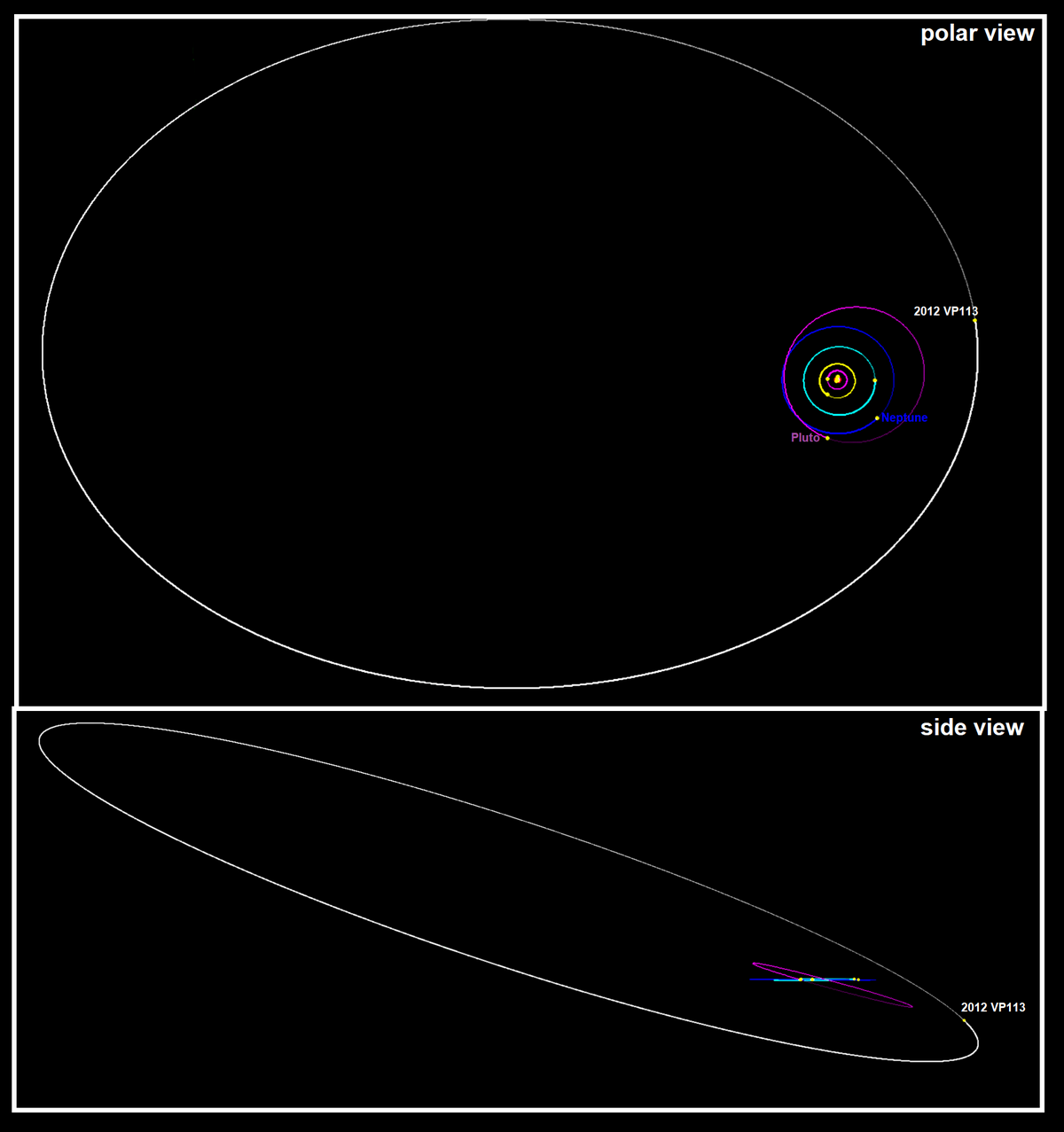
This orbit diagram shows the paths of Oort cloud objects 2012 VP113 (red) and Sedna (orange), which circle the Kuiper belt (blue) at the Solar System's edge.
The Solar System just got a lot more far-flung. Astronomers have discovered1 a probable dwarf planet that orbits the Sun far beyond Pluto, in the most distant trajectory known.
Together with Sedna, a similar extreme object discovered a decade ago2, the find is reshaping ideas about how the Solar System came to be. “It goes to show that there’s something we don’t know about our Solar System, and it’s something important,” says co-discoverer Chad Trujillo, an astronomer at Gemini Observatory in Hilo, Hawaii. “We’re starting to get a taste of what’s out beyond what we consider the edge.”
Trujillo and Scott Sheppard, an astronomer at the Carnegie Institution for Science in Washington DC, report the finding today in Nature.
“This is a great discovery,” says Michael Brown, a planetary astronomer at the California Institute of Technology in Pasadena. “We’ve been searching for more objects like Sedna for more than 10 years now.” Finding another one like it reduces the chances that Sedna is a fluke, he says. But astronomers now have to come up with ideas to explain how these objects remain tightly gravitationally bound to the Sun when they orbit so far away.
The newfound object's official name is 2012 VP113, but the discovery team calls it VP for short, or just 'Biden' — after US Vice-President Joe Biden. In several years time, after observations have pinned down its orbit, the scientists will submit a name for consideration by the International Astronomical Union (IAU), the organization in charge of celestial nomenclature.
Nature Podcast
Kerri Smith talks to Chad Trujillo about the newly discovered orb.
Bleeding edge
The classical planetary portion of the Solar System ends at Neptune, which orbits the Sun at about 30 times the Earth–Sun distance, a cosmic yardstick known as an astronomical unit (AU). One AU is approximately 150 million kilometres. Beyond Neptune is a realm of icy bodies, known as the Kuiper belt, that includes Pluto. This region stretches from roughly 30 to 50 AU. And beyond that lies the Oort cloud, with Sedna at its inner edge and comets farther out.
2012 Vp113 Astrology
Sedna never gets any closer to the Sun than 76 AU. 2012 VP113, although still in the inner Oort cloud, is even more remote: at its closest, it is 80 AU away.
Scott S. Sheppard/Carnegie Institution for Science
The red, green and blue dots show the movement of 2012 VP113 over a period of several hours on 5 November 2012.
The body is so distant that when Sheppard first spotted it, it was the slowest-moving astronomical object he had ever seen. The farther away something is, the slower it seems to move across the sky. Trujillo and Sheppard have been hunting for distant objects with the Dark Energy Camera, a 520-megapixel camera on the 4-metre Blanco telescope at the Cerro Tololo Inter-American Observatory in Chile. They captured 2012 VP113 during their first observing run, in November 2012, on the fifth image of the hundreds they would eventually snap. “We got lucky right away,” says Sheppard.
2012 Vp113
For months they tracked the object, until its full orbit became more apparent. But whereas Sedna can stray as far as 1,000 AU from the Sun, 2012 VP113 gets no further than about 452 AU. It seems to be more closely bound by the Sun’s gravity, which is something of a mystery, says Sheppard.
Origin stories
At 450 kilometres across, 2012 VP113 is about half the size of Sedna. If, as scientists expect, it is made mostly of ice, then its gravity probably pulls it into a spherical shape. This would qualify it as a dwarf planet under the revised rules of planethood drawn up by the IAU in 2006.
There are several competing ideas for how objects such as Sedna and 2012 VP113 got to where they are today. One leading hypothesis proposes that in the Solar System’s infancy, a nearby star gravitationally perturbed the coalescing system and dragged some fragments out towards the edge. Another possibility is that a massive rogue planet passed through at some point, kicking objects from the Kuiper belt outwards into the inner Oort cloud.
2012 Vp113 Wikipedia
Either way, Sedna and 2012 VP113 may be just the tip of the iceberg, says Megan Schwamb, an astronomer at the Academia Sinica in Taipei, Taiwan. She has looked for Sedna-like objects before3, and has modelled how much material could be out there. The inner Oort cloud could contain some 10–100 times the mass of the Kuiper belt, she says.
2012 Vp113 Planet
Trujillo and Sheppard estimate that there are hundreds more inner Oort objects waiting to be found. They are currently tracking six more candidates that could belong to extreme parts of the Solar System.